
5 Wax in Ears Symptoms Most People Spend Weeks Blaming on Something Else

Aarti Raicha • April 23, 2026

In a survey of nearly 500 patients with confirmed earwax blockage, over 60% described their symptoms as very or extremely bothersome — and most of them had been living with those symptoms for weeks before seeking help, not because they weren't bothered enough to act, but because they didn't know what they were dealing with.

By the time most people book an appointment, they've already quietly adapted to hearing less than they should.


5 Signs You've Had Earwax Buildup for Too Long

1. Muffled hearing that won't clear

Earwax blockage rarely starts dramatically. It's slow dimming — a conductive hearing loss, meaning sound is physically blocked before it reaches the eardrum rather than the eardrum itself being damaged. Most people don't notice how much their hearing has shifted until something forces the comparison — a phone call that feels harder to follow than it used to, a conversation in a noisy room that requires more concentration than it should, a moment where someone repeats themselves, and you realise it's been happening more often than you've been willing to admit. 


One patient came in after a week of ringing in her ear, not entirely sure what the problem was, but it turned out to be earwax.


What makes this symptom so easy to dismiss is that it develops gradually enough to feel normal. The brain adjusts, fills in the gaps, and stops flagging it as a problem. By the time most people act on it, the blockage has been building for weeks, sometimes months. That matters because the longer compacted earwax sits against the eardrum, the more firmly it sets, and the harder it becomes to shift without professional removal.

The hearing loss itself is entirely reversible once the wax is cleared, and sound comes back in fully. But that can only happen once someone looks inside the ear.


2. Ringing in the ears that keeps coming back

When compacted earwax sits directly against the eardrum, the pressure interferes with how the ear processes sound and can trigger tinnitus — the persistent ringing, buzzing, or low hum that seems to come from inside the ear itself. In the same survey, half of all patients with earwax blockage were experiencing tinnitus alongside their hearing difficulty, and most had been managing the ringing for weeks, assuming it was a separate, unrelated problem.


That assumption is understandable. Tinnitus has a reputation as a standalone condition, something brought on by loud noise exposure or stress, and so people treat it accordingly — they look up coping strategies, download white noise apps, wait for it to pass. What they don't consider is that the ringing started around the same time their hearing felt slightly off, which is usually the clearest indicator that earwax is involved.


Earwax-related tinnitus typically resolves the moment the blockage is cleared. People who had quietly accepted a permanent ringing often find it gone entirely after a single microsuction appointment, which is a significant thing to have spent weeks worrying about unnecessarily.\


3. A feeling of fullness or pressure in the ear

The sensation of fullness or pressure in the ear — the same feeling you get stepping off a flight or surfacing after a swim — is one of the most consistently misread earwax symptoms there is. Because it isn't painful, it tends to get blamed on sinus congestion, a cold that hasn't fully cleared, or jaw tension, and then tolerated for far longer than it should be.


It's worth understanding what's actually happening. Earwax is physically occupying space inside the ear canal, and the pressure is the ear's response to being blocked. It doesn't fluctuate the way sinus pressure does — it doesn't ease when you blow your nose or improve as a cold clears up. It stays at roughly the same level, day after day, until the blockage is removed. People who have been attributing it to their sinuses for three weeks and wondering why nothing is shifting are usually dealing with earwax, not congestion.


The distinction matters because the treatments are completely different. Decongestants won't touch an earwax blockage. Neither will waiting it out.


4. Unexplained dizziness or balance issues

The ear does more than hear — it also governs balance through the vestibular system, and when compacted earwax presses against the eardrum, it can send confusing signals that produce a mild but persistent sense of being slightly off-kilter or lightheaded. It's less common than the other symptoms on this list, but it's a recognised consequence of earwax impaction that regularly gets attributed to entirely unrelated causes — dehydration, tiredness, low blood pressure, and not eating enough.


The pattern that tends to give it away is that the dizziness has no other obvious explanation and coincides with other ear-related symptoms. If the ear feels full, hearing feels slightly reduced, and there's also an unsteady feeling that comes and goes, the ear should be the first thing checked rather than the last. A straightforward look inside the canal can confirm or rule out earwax as the cause in under a minute.


5. Struggling to follow conversations

This is the quietest symptom and, according to RNID research, one of the most consequential — one in five people with untreated earwax blockage reported poor mental health and feelings of isolation as a direct result. That figure is worth sitting with, because it describes something that starts small and compounds quietly over time.


When hearing becomes an effort, people start pulling back without fully realising it. Group conversations become harder to navigate, so they participate less. Restaurants and busy social settings feel more exhausting than enjoyable, so they get avoided. Phone calls require more concentration than they used to, so they get put off. None of these individual decisions feels significant in the moment — they feel like reasonable responses to circumstances — but taken together, they represent a gradual withdrawal from things that matter.


The cause, in many of these cases, is a blockage that takes around twenty minutes to clear.


When Should You Do Something About It?

If you recognise more than one of the symptoms above and they've been present for more than a couple of weeks, earwax is unlikely to clear on its own at that point. Olive oil drops can help with mild, early-stage build-up, but once earwax has compacted against the eardrum it needs to be physically removed rather than softened.


At Ealing Hearing Centre, we look inside the ear before doing anything else — confirming what's there and how best to treat it. If earwax is the cause, microsuction clears it the same day, and the difference is usually immediate.


Call 0800 002 5777 or book online at ealinghearing.co.uk.

By Aarti Raicha July 21, 2026
If you're dealing with blocked or uncomfortable ears, book a consultation and we'll talk you through what to expect based on your specific situation.
By Aarti Raicha June 30, 2026
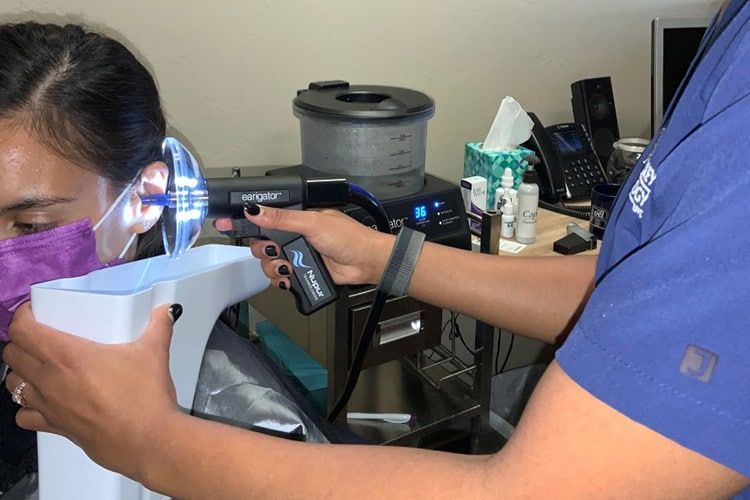
According to a 2023 review published in the British Journal of General Practice , roughly 2.3 million people in the UK need professional treatment for troublesome earwax every year, making it one of the most common reasons people see a GP about their ears. Despite how common it is, a lot of people still imagine the same scene when they think about having their ears cleaned, a large metal syringe, a tilted head over a bowl, a few uncomfortable minutes, and that picture is years out of date at most reputable clinics now. If “ear syringing near me” is the search that brought you here, here’s what’s actually changed, and why. Why syringing fell out of favour That same British Journal of General Practice review notes that manual water-filled syringes are no longer recommended in the UK, largely because of the risk of damage to hearing and the legal exposure that came with it. The old method relied on a clinician judging water pressure by hand, which left very little margin for error in a part of the body as delicate as the ear canal. Even the controlled, electronic irrigation that replaced it carries a real complication rate. A study published in BJGP Open put the risk of an ear infection called otitis externa following irrigation at around 3 per cent, which sounds modest until it’s scaled up. Across England and Wales, that works out to roughly 69,000 additional cases a year. None of this makes irrigation dangerous in the way the old manual method could be, but it does explain why so many clinics, ours included, have shifted toward an approach with a lower risk profile altogether. What’s actually recommended now NICE , the body that sets clinical guidance across the NHS, recognises three accepted methods for clearing earwax: electronic irrigation, microsuction, and manual removal using small instruments. Its guidance also rules irrigation out for some patients, including those with a history of a perforated eardrum, a current ear infection, or only one working ear. That’s a real shift from the old assumption that syringing was a one-size-fits-all fix for anyone with blocked ears. Whether the right method for you is microsuction, irrigation, or something else depends on your own ear history, and a proper look inside the canal first is what actually determines that, not which service happens to be advertised. Why microsuction has become the default At Ealing Hearing Centre, microsuction is our standard approach, and the reason comes down to control. The clinician can see the ear canal under magnification for the entire procedure, using gentle suction rather than water, so there’s no flushing and no pressure against the eardrum. It also sidesteps most of the reasons irrigation gets ruled out, which is part of why it’s become the preferred option for ear wax removal in London and well beyond it, not just within private practice. For most people, the whole procedure takes around twenty minutes, and the change in hearing is immediate once the blockage clears. So is “ear syringing” still a thing? In everyday language, the term has stuck around even though the original method largely hasn’t. Call most clinics today and ask for ear syringing, and what you’ll actually be offered is either electronic irrigation or microsuction, assessed against your ear history first rather than handed out by default. Whether you’d call it ear syringing, ear cleaning, or professional ear cleaning, the underlying decision is the same one: what’s actually in the canal, and which method suits it. Anywhere still offering the old hand-syringe method without checking your history first is worth being cautious of, given what the evidence now says about it.  Getting it looked at properly Whichever approach ends up being right for your ears, that’s a decision worth making after an otoscopic examination, not before one. At Ealing Hearing Centre, we examine the ear canal before recommending anything, and where professional ear cleaning or ear wax removal in Ealing, Stanmore, or the wider London area turns out to be the right next step, it can usually be arranged the same day. Call 0800 002 5777 or book online at ealinghearing.co.uk.
By Aarti Raicha June 26, 2026
A 2023 review in the British Journal of General Practice notes that earwax build-up can happen to anyone, but it shows up more often in older adults and in people who wear hearing aids or earbuds regularly, with around 2.3 million people across the UK needing professional help for troublesome earwax in a given year. For hearing aid users specifically, that build-up doesn’t always behave the way it does for everyone else, and it’s worth understanding the difference before assuming a device has simply stopped working properly. Why hearing aids change how earwax behaves Earwax normally makes its own way out of the ear canal, helped along by jaw movement and the slow outward migration of skin cells. A hearing aid dome, mould, or receiver sitting inside that canal gets in the way of that process, partly by physically blocking the path wax would otherwise take, and partly because the ear can respond to anything sitting inside it by producing more wax than usual. Devices that place more hardware directly in the canal, such as receiver-in-canal models or custom moulds, tend to be affected by this more than behind-the-ear styles with a more open fit. Signs it’s the wax, not the device A lot of people spend weeks troubleshooting a hearing aid before considering that earwax might be the actual cause. A few signs worth paying attention to: Whistling or feedback that wasn’t there before, even at the usual volume Sound that feels muffled or distant despite fresh batteries or a full charge A dome or mould that suddenly feels tighter or less comfortable than it used to Itching or a sense of fullness around where the device sits in the ear None of these confirm earwax on their own, since hearing aid components can fail for other reasons too, but they’re a reasonable prompt to get the ear looked at properly before adjusting settings or replacing parts. Why this needs a proper look rather than a home fix Cotton buds are a bad idea for anyone, but they’re a particular risk for hearing aid users, since the canal already has less space to work with and a bud can push wax further in more quickly than it would otherwise. Softening drops can help with mild build-up, but once wax has compacted against a mould or receiver that’s been blocking its way out for a while, drops alone usually aren’t enough. An otoscopic examination is the only reliable way to tell whether the issue is earwax, debris caught around the device itself, or a genuine hardware fault, and getting that distinction right saves you from troubleshooting the wrong problem for weeks. A routine that keeps things clearer for longer Wiping the device down daily, replacing wax guards on schedule rather than waiting for them to fail, and having the ear canal checked periodically rather than only after a problem develops all make a noticeable difference over time. For patients who find getting to a clinic difficult, mobile earwax removal brings the same otoscopic-led approach to the home, which matters particularly for older hearing aid users, who are also the group most likely to be affected by build-up in the first place. Looking after both together Because Ealing Hearing Centre fits hearing aids and treats earwax build-up under one roof, we can look at both sides of the problem in the same appointment rather than sending you elsewhere for half the picture. If your hearing aids have felt less effective lately, or you’ve been searching for ear wax removal near me without realising the two issues might be connected, it’s worth finding out which one is actually responsible. Call 0800 002 5777 or book online at ealinghearing.co.uk.