Why DIY Ear Wax Removal Fails and What to Do Instead
If you've spent the past week tilting your head over the bathroom sink, squeezing drops into your ear, and waiting for something to happen, you already know how frustrating ear wax removal can be when it doesn't go to plan.
You're not the only one stuck in that cycle. According to RNID, an estimated 2.3 million people in the UK need professional ear wax removal every year. A 2024 Healthwatch survey found that over 85% of respondents who tried to remove ear wax at home using drops were unsuccessful. That's a staggering failure rate for something most people assume they can handle themselves.
So what's going wrong? In most cases, the methods people rely on either don't address the real problem, create new complications, or attempt removal without the tools needed to do it safely. This guide breaks down the methods that consistently fail, explains why, and helps you decide when a different approach is worth considering.
Why More People Are Attempting DIY Removal Than Ever
There was a time when a quick visit to your GP surgery would sort out a blocked ear. That's no longer the case for millions of people across England.
In 2020, NHS guidelines reclassified ear wax removal as a non-core service, meaning GP practices are no longer required to offer it. By early 2024, RNID research found that nearly 10 million people in England had lost access to free NHS ear wax removal entirely. Their 2022 report revealed that two-thirds of people with ear wax buildup were told the service was no longer available through their GP.
The result is predictable. More people are turning to home remedies, pharmacy products, and the growing market of DIY ear cleaning gadgets promoted on social media. Some of these methods are harmless but ineffective. Others carry real risks.
Ear Candling and the Clinical Evidence Against It
Ear candles are hollow fabric cones soaked in beeswax or paraffin. You lie on your side, place the narrow end in your ear, and light the opposite end. The claim is that the flame creates a vacuum that draws wax up and out of your ear canal. After the candle burns down, the waxy residue inside the cone is presented as proof that it worked.
The problem is that the residue isn't ear wax. It's melted candle wax and burned fabric.
A clinical trial published in The Laryngoscope evaluated ear candling on eight ears and found that no cerumen was removed from any of them. The same researchers surveyed 122 ear, nose, and throat specialists and documented 21 injuries caused by the procedure, including burns to the face and ear, blockages caused by dripped candle wax entering the canal, and eardrum perforation.
Despite this evidence, ear candles remain widely available online and in health shops. If you've tried them and felt like your hearing improved briefly, the warmth and relaxation of lying still may have provided temporary relief, but the wax itself hasn't gone anywhere.
Social Media Ear Cleaning Tools and Why Doctors Are Raising Concerns
A newer trend is the wave of ear cleaning gadgets sold online and promoted through viral videos. These include spiral-tipped picks, miniature scoops, and WiFi-connected ear cameras (endoscopes) that let you watch the inside of your ear canal on your phone screen while you scrape.
The videos are undeniably satisfying to watch, and the tools look precise. But ENT specialists are increasingly speaking out about the risks. Consultant ENT surgeon Amit Parmar warned in a 2025 Midland Health advisory that these devices give people a false sense of control and can damage the ear canal, eardrum, or even the small bones of hearing behind it. Searches for "ear wax removal tools" had increased by 20% in the month before his warning was published.
A separate UK audiology review of TikTok content examined videos relating to at-home ear wax removal and ranked 14 different hacks by danger level. The reviewing audiologist noted that many of the methods shown have no evidence supporting their effectiveness and that several could lead to permanent hearing loss.
The core issue with all of these tools is the same. Your ear canal is roughly the width of a pencil and lined with extremely thin, sensitive skin. Even with a camera feed on your phone, you're operating without the magnification, lighting, and clinical training that professionals rely on. One slip, one sneeze, or one moment of misjudging depth can cause real injury.
Home Flushing Without the Right Conditions
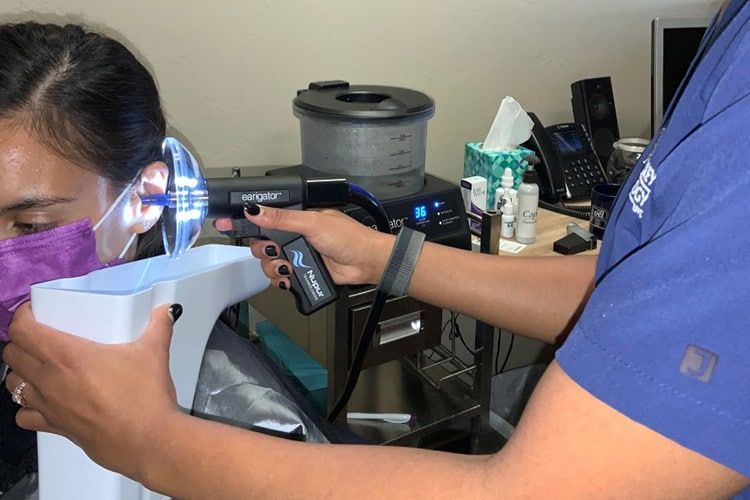
Flushing the ear with warm water is a legitimate removal method when performed by a trained professional. Many people reason that if their GP used to do it with a syringe and warm water, they can replicate the process at home with a bulb syringe or squeeze bottle.
The logic makes sense on the surface, but there are critical differences that make home flushing risky.
Temperature matters more than most people realise. Water that's even slightly too cold can trigger a sudden onset of dizziness and vertigo by stimulating the vestibular system in your inner ear. Water that's too warm risks burns to the delicate canal skin. Professionals use water calibrated to body temperature for exactly this reason.
Pressure is another concern. Too much force from a syringe can push water and wax against the eardrum rather than flushing it out. A study published in the BMJ found that complications from ear syringing, even when performed by trained practice staff, occurred in roughly 1 in 1,000 procedures. Those complications included eardrum perforation, canal lacerations, and failure to remove the wax at all.
The final issue is visibility. At home, you can't see whether the wax is shifting, whether the angle of the water is correct, or whether your eardrum is intact before you begin. Professionals examine the ear with an otoscope before attempting any removal, which is the step that makes the entire procedure safe.
How Cotton Buds and Drops Can Work Against You
These are the two methods almost everyone tries first, and we've covered them in detail in our earlier post on what to do when everything you've tried has failed. The short version is that cotton buds remove surface wax but push the rest deeper, compacting it against the eardrum and turning a minor buildup into a dense plug. Over-the-counter drops work best on soft, recent wax, but once wax has hardened and impacted, drops alone rarely resolve it.
If you've been using drops for more than five days without improvement, or if your ear feels more blocked since you started using cotton buds, that earlier guide walks through what's happening and why professional removal becomes the practical next step.
How to Tell If Wax in Ears Is Actually Causing Your Symptoms
Before committing to any removal method, it's worth confirming that wax is genuinely the issue. Several common wax in ears symptoms overlap with other conditions, and treating the wrong problem wastes time and can cause harm.
The most recognisable sign of wax buildup is a drop in hearing, usually in just one ear. You might also notice a persistent fullness or plugged sensation that won't clear no matter how many times you try to pop your ear. Tinnitus (ringing, buzzing, or whooshing sounds), earache, deep itchiness in the canal, and occasional mild dizziness are also associated with impacted wax.
If you're experiencing hearing loss in both ears at the same time, persistent pain that doesn't respond to over-the-counter painkillers, discharge, fever, or sudden severe vertigo, these symptoms may point to infection, eustachian tube dysfunction, or other conditions that need clinical assessment. Professional evaluation is the only reliable way to confirm the cause and make sure you're not treating wax when something else is going on.
For a deeper look at how wax symptoms are commonly mistaken for other problems, our post on wax in ears symptoms people spend weeks misidentifying covers this in more detail.
How to Prevent Wax Buildup So You Don't End Up Here Again
Once the blockage is resolved, prevention saves you from repeating the cycle. The habits that matter most are simple but consistently overlooked.
The single most effective thing you can do is stop putting anything inside your ear canal. No cotton buds, no spiral tools, no bobby pins. Clean the outer ear only, using a warm damp cloth after showering. Your ear canal is designed to clean itself through the natural outward migration of skin cells and wax, and the less you interfere with that process, the better it works.
If you wear earbuds, in-ear headphones, or hearing protection regularly, give your ears breaks throughout the day. These devices block the natural exit path for wax and can gradually push it deeper with each insertion. Removing them for even short periods allows wax to migrate outward as it should.
For people who naturally produce more wax or have a history of recurring buildup, a weekly routine of a few drops of olive oil or almond oil can make a meaningful difference. Lie with the treated ear facing upward for five to ten minutes, then let it drain naturally. This keeps wax soft enough to exit on its own and prevents the hardening that leads to impaction.
Finally, if you've had impacted wax more than once, consider scheduling a professional check every six to twelve months. Catching early buildup before it causes symptoms is far easier and more comfortable than dealing with a full blockage. Think of it as routine maintenance for your ears, no different from regular dental check-ups for your teeth.
The Bottom Line
DIY ear wax removal fails for a consistent reason. Most home methods either push wax deeper, partially treat it, or attempt removal without the visibility and precision needed to do it safely. The growing number of social media tools and viral hacks hasn't changed this. If anything, it's introduced new risks to a process that was already difficult to manage at home.
If you've been dealing with blocked ears, muffled hearing, or persistent wax in ears symptoms that won't respond to home treatment, professional assessment is the fastest route to relief. An experienced hearing specialist can identify the problem in seconds and clear it in minutes through safe, controlled methods like microsuction or irrigation.
Get in touch with Ealing Hearing Centre to book a consultation. Your ears will thank you for it.